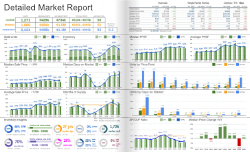
Highlights
-
Sarasota’s stronger sales drove the regional increase, moving the county toward seller-leaning balance.
-
The median declined while the average rose sharply, making sales mix central to interpreting September prices.
-
Inventory contracted more than in Manatee County, leaving buyers with fewer alternatives.
-
Countywide marketing time shortened, but several local areas remained slower despite more closings.
-
Seller leverage improved unevenly, with coastal and luxury supply still higher than the county average.
Market Conditions
Sarasota County tightened in September 2026 as completed sales increased and available inventory declined. Months of supply fell from 5.5 to 3.7, shifting from balanced-to-buyer-leaning conditions toward a seller lean. The county helped lift regional activity, while neighboring Manatee County recorded a small sales decline. The figures combine single-family homes, condos, townhomes, and villas, with year-over-year comparisons to September 2025.
This is a recovery in completed activity relative to last September, rather than evidence of a uniform price rebound. County sales and supply measures improved, but pricing moved in opposite directions. Buyers also faced different conditions across the county, from 3.1 months of supply in East Sarasota to 6.1 months in West Sarasota & Downtown.
Historical September readings provide perspective. County supply was 3.6 months in 2019 and only 0.8 months in 2021. September 2026 was close to the earlier balance reading, while its 56-day median marketing time remained above 2019’s 48 days. Sellers have more support than last year without the extraordinary speed of the shortage years.
Pricing Trends
The median sale price, the midpoint of the sales distribution, declined 4.9% from $450,000 to $428,000. The average, which is more affected by expensive transactions, increased 41.7% from $643,000 to $911,000. A higher average alongside a lower median does not show that typical homes appreciated at the average’s rate.
The county’s internal results underline that distinction. The Sarasota Keys average reached $3,880,000, and the Sarasota Luxury Market average reached $4,800,000. Meanwhile, Central Sarasota and East Sarasota recorded lower median and average prices than last September. Expensive closings may have lifted the county average while other parts of the sales distribution shifted lower.
Sarasota’s median was close to Manatee’s $420,000, but its average was much higher than Manatee’s $544,000. That gap highlights the importance of the upper end when comparing county averages. The tables do not establish changes in the value of the same homes over time.
Inventory Trends
Inventory declined 23.7%, from 5,405 to 4,125 properties, a reduction of 1,280 listings. The contraction was larger than the region’s 17.9% decline and Manatee County’s 10.3% decline. Buyers faced fewer alternatives, and sellers competed against a smaller pool of active listings.
South Sarasota County recorded a 27.9% inventory decline and 3.3 months of supply. The Sarasota Keys still carried 5.1 months, while West Sarasota & Downtown had 6.1 months. Reduced county inventory therefore improved sellers’ position without removing meaningful buyer choice in every segment.
Market Pace
Closed sales increased 33.8%, from 739 to 989, accounting for more than the region’s net increase because Manatee sales declined. September closings also slightly exceeded the 984 recorded in 2019, although they remained below the 2020 and 2021 totals.
Median days on market fell from 76 to 56 days. That improvement was not universal: Central Sarasota rose from 51 to 59 days, and West Sarasota & Downtown rose from 88 to 94 days. Completed activity strengthened countywide, but those local results show why more closings do not always mean faster sales.
What This Means for Buyers
Buyers should narrow their comparisons to the relevant neighborhood and property category. Lower county inventory calls for prompt decisions on a well-priced match, especially in tighter southern and eastern areas. Coastal and luxury buyers can still compare a broader supply relative to sales, while the county’s higher average should not be treated as a universal increase in values.
What This Means for Sellers
Sellers benefit from fewer competing listings and more completed sales, but the lower median argues for careful pricing. Use current comparable closings instead of the county average to set an asking price. Preparation and realistic marketing expectations remain especially important in areas where days on market increased despite stronger activity.