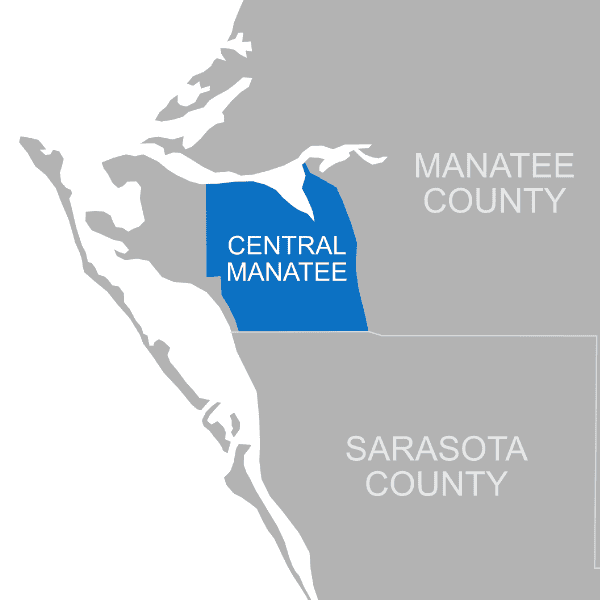
Central Manatee

Homes, Lifestyle, & Market Trends
Central Manatee is the portion of Manatee County south of the Manatee River, east of 26th Street West, and west of I-75. That boundary captures much of central Bradenton along with surrounding residential areas that sit between coastal West Manatee and the newer growth east of the interstate.

For buyers, Central Manatee is largely about location and variety. This is an established part of the county where older neighborhoods, newer communities, condos, villas, waterfront properties, and everyday commercial corridors exist relatively close together.

It provides access to downtown Bradenton and the Manatee River without putting buyers as far west toward the beaches or as far east into Manatee County's expanding suburban communities.

Central Manatee is part of Manatee County and the Sarasota & Manatee County Overview.

What is Central Manatee Like?

Central Manatee does not have one uniform look or personality. It is better understood as the established middle of the Bradenton area.

The northern portion reaches the Manatee River and includes downtown Bradenton and neighborhoods near the river. Bradenton's Riverwalk runs along the waterfront and has become one of the city's defining public spaces. The City of Bradenton describes the original Riverwalk as extending about 1.5 miles along the Manatee River, with expansion continuing eastward.

Move south from downtown and the environment changes quickly. There are older residential streets, mid-century homes, condominium communities, apartment developments, commercial corridors, and pockets of redevelopment. The Village of the Arts adds another distinctive piece to the area, with historic cottages used for residences, studios, galleries, shops, and restaurants.

Farther east, neighborhoods generally begin to feel more suburban. Development patterns tend to become newer as buyers approach I-75, although Central Manatee does not have the same concentration of large-scale new construction and master-planned development found east of the interstate.

That distinction matters. Central Manatee is primarily an established market rather than a blank canvas for new development. Streets, neighborhoods, shopping areas, and housing have accumulated over decades. Two homes separated by only a few miles can therefore offer very different ownership experiences.

For buyers who enjoy comparing houses individually rather than choosing among a handful of builder floor plans, that diversity can be an advantage.

The Central Manatee Lifestyle

Central Manatee's strongest lifestyle feature may be practicality.

Living between 26th Street West and I-75 places residents near many of Bradenton's everyday destinations while preserving reasonable access in several directions. Downtown Bradenton, medical services, shopping, restaurants, parks, schools, and major roads are distributed throughout the area rather than concentrated in a single town center.

Downtown provides the area's most urban environment. The Manatee River, Riverwalk, Old Main Street, and surrounding civic and commercial areas give this part of Central Manatee a stronger sense of place than the more suburban neighborhoods farther south and east.

The surrounding road network also makes Central Manatee useful as a home base. Manatee Avenue and State Road 64 provide major east-west routes, while US 301 and other north-south roads connect different parts of Bradenton and the surrounding county. I-75 forms our eastern boundary, giving buyers on that side of Central Manatee convenient access to the interstate.

Heading west leads toward West Manatee and eventually Anna Maria Island. Heading east leads toward newer development, including the Lakewood Ranch area and other growing parts of eastern Manatee County.

Central Manatee works well for people who want to be in the middle of things without necessarily paying for a beach, island, or master-planned-community lifestyle.

The tradeoff is that convenience does not always mean tranquility. Major corridors can be busy, particularly during peak commuting periods and the winter season. Some neighborhoods feel tucked away from that activity, while homes directly along or near commercial roads can have a very different atmosphere.

Walkability varies just as much. Downtown and a few surrounding districts provide opportunities to reach restaurants, parks, events, and services without relying entirely on a car. Across much of Central Manatee, however, daily life remains car-oriented.

That is why buyers should evaluate this area neighborhood by neighborhood rather than relying on the Central Manatee label alone.


Downtown Bradenton and the Manatee River
Downtown Bradenton deserves special attention because it creates one of the biggest internal contrasts within Central Manatee.

The Manatee River gives downtown a waterfront identity that is very different from the suburban portions of the HLA. Riverwalk provides recreation and public space along the river, while downtown offers restaurants, businesses, government services, events, and cultural destinations.

The city has also designated Downtown, Central, and Tamiami Trail Community Redevelopment Areas, reflecting ongoing investment and redevelopment in portions of Bradenton's urban core.

For buyers, downtown can mean condominium living, smaller residential properties, older homes, or neighborhoods where redevelopment is occurring alongside established housing.

It also means accepting a more urban environment. Buyers comparing downtown with a subdivision several miles away are not simply comparing two houses. They are choosing between substantially different lifestyles.

Homes & Housing in Central Manatee

Housing variety is one of Central Manatee's defining characteristics.

Single-family homes make up a significant part of the residential landscape, but there is no single Central Manatee house. Depending on the neighborhood, buyers may encounter modest older homes, renovated mid-century properties, larger residences, newer construction, townhomes, villas, condominiums, gated communities, and homes along lakes, canals, or the Manatee River.

Older housing can be especially interesting here.

An established home may provide a larger lot, mature landscaping, a location close to downtown, or a neighborhood without the structure and expenses associated with a newer master-planned community. Some buyers specifically prefer that independence.

The tradeoff is that age matters in Florida real estate.

A beautifully renovated kitchen does not tell you the age or condition of the roof, electrical system, plumbing, HVAC equipment, windows, or other components that can affect maintenance and insurability. When comparing an older Central Manatee home with newer construction farther east, buyers should look beyond purchase price and finishes to consider the total ownership picture.

That can change the value equation considerably.


Condos, Villas and Lower-Maintenance Living
Central Manatee also provides alternatives for buyers who do not want the responsibilities of a detached single-family home.

Condos and villas can reduce exterior maintenance and may provide community amenities. They can appeal to seasonal residents, downsizers, and buyers who would rather spend less time maintaining a yard or exterior.

But lower maintenance does not automatically mean lower cost.

Association fees, insurance arrangements, reserves, maintenance responsibilities, rules, and potential assessments should all be reviewed carefully. The financial health of the association can be just as important as the condition of the individual unit.

Rental policies also vary. Buyers planning to use a property seasonally and rent it when they are away should verify both association restrictions and applicable local regulations before purchasing. Within Bradenton city limits, for example, qualifying short-term vacation rentals are subject to city registration requirements.

The listing photos only tell part of the story. With attached housing, buyers are purchasing into the financial and operational structure of the community as well as the residence itself.


Waterfront Property in Central Manatee
Central Manatee's northern boundary along the Manatee River creates opportunities for waterfront living, but waterfront here is different from living on Anna Maria Island or Longboat Key.

Some buyers are less interested in walking to a Gulf beach than they are in river views, boating access, or simply being near the water while remaining closer to mainland Bradenton.

Waterfront properties require additional due diligence. Flood exposure, elevation, insurance, seawalls, docks, water depth, bridge clearance, and boating access can vary by property. Buyers interested in keeping a boat at home should verify whether a particular property actually supports the type of boating they intend to do.

A dock in a listing photo is not the same thing as useful boating access.

The same principle applies to flood risk throughout Central Manatee. Risk can vary significantly even within relatively short distances, so flood-zone information, elevation, insurance availability, and property-specific history should be evaluated for the individual home rather than assumed from the neighborhood name.


Established Neighborhoods vs. Newer Construction
One of the most useful comparisons for a Central Manatee buyer is not necessarily Central Manatee versus another city. It is established Bradenton versus newer East Manatee.

Central Manatee generally gives buyers more older housing, mature neighborhoods, existing commercial infrastructure, and proximity to downtown Bradenton. Buyers may also encounter communities without CDD fees and homes outside large master-planned developments, depending on the property.

East of I-75, the balance shifts toward newer construction and larger planned communities. Buyers may gain newer building standards, modern floor plans, extensive community amenities, and newer infrastructure, but those benefits can come with HOA structures, CDD obligations, smaller lots, or additional community rules.

Neither approach is inherently better.

Someone who wants a newer home, community pool, planned trails, and neighborhood amenities may happily accept those costs. Someone who wants an established lot, fewer community restrictions, and easier access to central Bradenton may prefer the opposite.

Central Manatee gives buyers considerably more of the second option while still offering newer housing in selected locations.
INVENTORY INSIGHTS
ALL HOME TYPES
589
HOMES ON MARKET
$240k - $505k
TYPICAL PRICE
MEDIAN AGE
34
YEARS
MED SIZE
1,536
SQUARE FEET
NEW CONSTRUCTION
4%
WATER VIEW
16%
WATER ACCESS
29%
HAVE HOA FEES
80%
HAVE CDD FEES
6%
HOA FEES
$4,944
MEDIAN ANNUAL
CDD FEES
$1,604
MEDIAN ANNUAL
Updated October 6, 2026

Central Manatee Real Estate Market

Central Manatee and Downtown moved into balanced conditions in August. Closed sales remained stable while inventory declined sharply, reducing months of supply from 5.0 to 3.5 months.

A total of 129 homes sold, compared with 130 in August 2025. That 0.8% decline represents little meaningful change in activity. The larger shift occurred in available supply, which fell more than 27%.

Central Manatee finished the month close to Manatee County’s 3.3 months of supply. The market was tighter than it was last summer, but the modest price declines show that reduced inventory did not give sellers unrestricted leverage.

Who is Central Manatee Best Suited For?

Central Manatee makes the most sense for buyers who value location, housing choice, and access to established Bradenton more than having one highly defined community lifestyle.

It can be particularly compelling for someone who wants reasonable access to downtown Bradenton, the Manatee River, shopping, medical services, I-75, and the beaches without living at either geographic extreme.

It also deserves consideration from buyers who prefer established neighborhoods. Mature landscaping, individual architecture, larger or less standardized lots, and communities without extensive amenity packages can be appealing alternatives to newer master-planned development.

Buyers seeking an urban or semi-urban experience can focus closer to downtown and the river. Those wanting a conventional suburban neighborhood can look farther south or east within the HLA.

Central Manatee may be less appealing to buyers whose first priority is walking to the Gulf beaches. Those buyers should compare the Manatee Keys or portions of West Manatee.

Likewise, buyers who want extensive new construction, resort-style community amenities, newer schools and infrastructure, or a highly planned suburban environment may prefer to compare East Manatee or Lakewood Ranch.

That ability to compare is important because Central Manatee occupies the middle ground geographically and, in many ways, philosophically. It is neither coastal-island Manatee nor the county's newest suburban frontier.

Conclusion

Central Manatee is difficult to summarize with a single neighborhood stereotype, and that is precisely what makes it useful for buyers.

This is an established and varied part of Manatee County. Downtown living near the Manatee River can feel completely different from a quiet residential street several miles south. An older home without an HOA presents a different ownership equation from a condo or gated community. A waterfront property introduces considerations that may be irrelevant just a few blocks inland.

The key is knowing which version of Central Manatee fits what you are trying to accomplish.

Zarghami Group | KW Coastal Living III
401 N Cattlemen Road Suite 308
Sarasota, FL 34232
941-241-3622
Subscribe to our newsletter
The latest news, articles, and resources, sent to your inbox.
© 2025 Zarghami Group | KW Coastal Living III. All rights reserved.