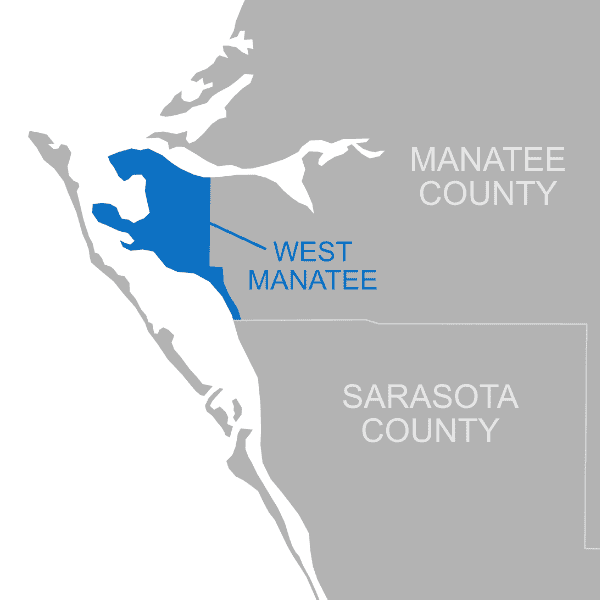
West Manatee has one of the more varied housing stocks in Manatee County because it was not built all at once.
Buyers will encounter established single-family neighborhoods, waterfront properties, condominiums, villas, townhomes, gated communities, newer construction, and individual homes that have been extensively renovated or replaced. Age, construction style, lot size, community structure, and proximity to water can change significantly within a relatively short distance.
Established single-family neighborhoods make up a substantial part of the area. For buyers who value mature landscaping, larger lots in some neighborhoods, and streets that do not feel newly developed, these areas can be appealing. They may also offer an alternative to the more tightly controlled environment found in newer master-planned communities.
The tradeoff is that older housing requires more property-specific investigation.
Roof age, plumbing, electrical systems, windows and doors, HVAC equipment, previous renovations, permits, and insurability may all matter. Two homes of similar size on neighboring streets can have very different ownership costs depending on how they have been maintained and updated.
Some buyers specifically prefer that. An established home may offer a location, lot, vegetation, or neighborhood character that would be difficult to reproduce in a new subdivision.
Other buyers would rather have newer systems and fewer immediate renovation decisions. West Manatee has newer construction and redevelopment as well, although the experience is different from buying in a large new-home corridor farther east. Here, newer homes may appear as individual infill properties or smaller developments mixed into an older residential landscape.
Condos and villas provide another path into West Manatee, particularly for buyers who prioritize lower exterior maintenance, seasonal use, or proximity to the coast. But association costs and rules become part of the buying decision.
Buyers should review the specific association's fees, reserves, insurance structure, assessments, maintenance responsibilities, rental policies, pet rules, and other restrictions before deciding that a condominium is the simpler or less expensive choice. Florida condominium ownership can shift certain maintenance responsibilities away from the individual owner, but those expenses do not disappear. They are handled differently.
Waterfront Homes in West Manatee
Waterfront real estate deserves to be treated as its own category.
A waterfront home along the Manatee River, Palma Sola Bay, a canal, or another coastal waterway may offer a lifestyle that an inland property cannot. Views, docks, fishing, kayaking, boating, and sunsets can all become part of the value equation.
They also add another layer of due diligence.
Flood exposure, elevation, insurance, seawalls, docks, lifts, shoreline conditions, and storm vulnerability may materially affect the cost of ownership. A beautiful dock can be an asset. A seawall approaching the end of its useful life can represent a significant future expense.
Buyers should investigate these issues during the purchase process rather than relying on assumptions based on neighboring properties. Flood designations, insurance requirements, and physical conditions can vary property by property.
The same principle applies even away from obvious waterfront locations. West Manatee is a coastal area with low-lying sections, bays, rivers, canals, and tidal environments. Flood exposure should be evaluated for the individual property rather than assumed based simply on how far a house appears to be from the shoreline.
Established West Manatee vs. Newer East Manatee
One of the most useful comparisons for buyers is West Manatee versus East Manatee.
East Manatee contains much of the county's newer growth, including large planned communities and extensive new construction. West Manatee is generally more established and geographically tied to the coast.
Neither approach is inherently better. They solve different problems.
A buyer who wants newer construction, community amenities, modern neighborhood planning, and convenient access to I-75 may lean east. Someone who cares more about beach access, boating, established neighborhoods, mature landscaping, or proximity to the bays may prefer west.
There are tradeoffs on both sides.
West Manatee buyers may encounter older homes, more property-specific maintenance questions, coastal insurance considerations, and beach-related traffic. East Manatee buyers may encounter greater distance from the Gulf, ongoing construction, denser new development in some locations, and HOA or CDD expenses depending on the community.
This is why comparing houses by square footage and price alone can be misleading. The decision is often really about which version of the Manatee County lifestyle you want.
West Manatee vs. the Manatee Keys
Buyers focused on the coast should also compare West Manatee with the Manatee Keys, which Zarghami Group defines as Anna Maria Island and the Manatee County portion of Longboat Key.
West Manatee keeps you on the mainland. The Manatee Keys put you on the barrier islands.
That sounds like a small geographic distinction. In daily life, it can be a major one.
Island buyers may prioritize walking or biking to the beach, Gulf views, boating, vacation-oriented surroundings, or the distinctive character of individual island communities. West Manatee buyers can still reach those places easily while remaining closer to mainland shopping, services, and routes leading toward the rest of Bradenton.
The ownership considerations can differ as well. Property type, insurance, flood exposure, rental regulations, condominium structures, and maintenance requirements vary significantly throughout both markets.
For some buyers, nothing substitutes for waking up on an island.
For others, being able to drive onto the island whenever they want and drive back to a mainland home is exactly the point.