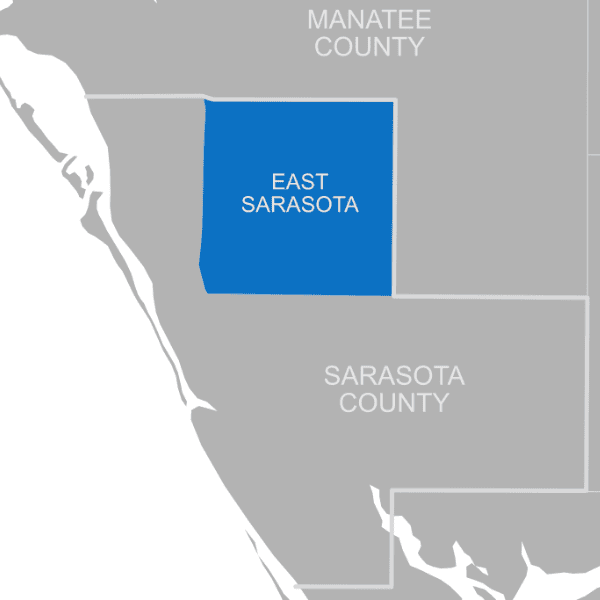
East Sarasota

Homes, Lifestyle, & Market Trends
East Sarasota is a broad real estate market that stretches from the rapidly developing areas just beyond I-75 into some of Sarasota County’s most rural landscapes.

That range is what makes East Sarasota interesting. Buyers can find established golf and gated communities, newer master-planned neighborhoods, large custom homes, acreage and equestrian properties, along with places where cattle pastures and natural land still dominate the view.

The farther east you travel, the less East Sarasota feels like suburban Sarasota at all.

For buyers who want more land, newer housing, privacy or room to breathe without completely disconnecting from Sarasota, this is an important part of the county to understand.

East Sarasota is part of Sarasota County and the Sarasota & Manatee County Overview.

What is East Sarasota Like?

The easiest way to understand East Sarasota is to think of I-75 as a dividing line rather than a destination. Immediately east of the interstate, Sarasota still feels suburban. Major roads such as Fruitville Road, Bee Ridge Road and Clark Road connect these neighborhoods back to shopping, employment, medical services, downtown Sarasota and the coast.

Move farther east, however, and the character begins to change.

Development becomes less continuous. Larger parcels appear. Roads pass through stretches of pasture, woods and open land. Communities may be separated by considerable undeveloped acreage rather than blending directly into one another. Eventually, the landscape becomes distinctly rural around areas such as Old Miakka and the approaches to Myakka River State Park.

That distinction matters because two homes described as being in East Sarasota can offer completely different versions of Sarasota living.

A home relatively close to I-75 might be in a gated community with sidewalks, community amenities and neighboring homes a short distance away. Another property farther east might sit on several acres with a barn, detached building, private well and septic system. Both can legitimately be part of the East Sarasota market, but the ownership experience is very different.

East Sarasota is also one of the places where Sarasota County’s future growth is particularly visible. County planning documents have identified major residential development east of I-75, and large projects continue to move through the planning and development process.

As a result, the area sits at an unusual intersection of old and new Sarasota. Long-established rural properties can be only a few miles from recently built neighborhoods. Open land may eventually become another village or community. A quiet road today may play a different role as development continues.

For buyers, the lesson is simple: location within East Sarasota matters enormously.

East Sarasota Lifestyle

East Sarasota appeals to buyers who want some separation from Sarasota’s denser coastal corridor without giving up access to the city altogether.

Daily life tends to be car-oriented. This generally is not an area where buyers choose a home because they can walk to restaurants, coffee shops and entertainment. Instead, the attraction is often what happens when you arrive home: more space, newer neighborhoods, quieter streets, community amenities or enough property to create a lifestyle that would be difficult to reproduce closer to downtown.

The major east-west roads provide the connection back into Sarasota. Fruitville Road is particularly important for the northern part of the area, while Bee Ridge and Clark Road serve communities farther south. I-75 provides north-south access and creates a useful dividing line between East Sarasota and the more established areas west of the interstate.

The tradeoff is distance.

Living east of I-75 can mean putting more miles between home and Sarasota’s beaches, downtown and some of the county’s most concentrated restaurant and entertainment districts. How much that matters depends heavily on where you live within this very large area. A neighborhood just beyond the interstate is a very different proposition from acreage well east toward Myakka.

For some buyers, that is precisely the point. They would rather have space around the house than have the beach around the corner.

East Sarasota also has access to some of the county’s most significant natural landscapes. The Celery Fields on Palmer Boulevard includes trails, boardwalks and observation areas and is part of the Great Florida Birding and Wildlife Trail. Farther east, Old Miakka Preserve adds another natural area, while Myakka River State Park introduces an entirely different scale of undeveloped Florida landscape.

This is one of the few parts of greater Sarasota where a buyer can realistically choose between a polished gated-community lifestyle and something that feels much closer to country living without leaving Sarasota County.

Homes & Housing in East Sarasota

East Sarasota has one of the broadest housing mixes in the Sarasota market.

Closer to I-75, buyers will encounter conventional single-family neighborhoods, gated communities, golf-oriented communities and newer construction. Homes may have community pools, clubhouses, fitness facilities, sports courts or other shared amenities depending on the neighborhood.

This type of housing can appeal to buyers who want a more structured residential environment. The streets and common areas are maintained to community standards, amenities may be included within the neighborhood, and newer communities often provide contemporary floor plans that are difficult to find in Sarasota’s older neighborhoods closer to the coast.

The tradeoff is usually greater community regulation and additional ownership costs.

HOA fees vary significantly, as do the services they cover. Some communities may also have CDD obligations or other assessments. Buyers should look beyond the monthly or annual fee and understand what is actually included, what restrictions apply and whether additional assessments or district obligations affect the total cost of ownership.

The equation changes as you move into more rural portions of East Sarasota.

Here, buyers may find custom homes on larger lots, acreage properties, equestrian properties and residences with detached garages, workshops, barns or other improvements. Privacy and flexibility become bigger parts of the purchase decision.

For the right buyer, this can provide something increasingly difficult to find in Sarasota: meaningful land around the house.

But acreage requires a different kind of due diligence than buying in a subdivision.

A rural property may rely on a private well and septic system rather than centralized utilities. Access, drainage, wetlands, zoning and the permitted use of additional structures can matter. Buyers interested in horses, recreational vehicles, workshops or other specific uses should verify that a property actually supports what they intend to do with it.

Five acres on a listing sheet does not automatically mean five acres of equally usable land.

That is why comparing East Sarasota homes strictly by price per square foot can be misleading. The value proposition may include land, privacy, outbuildings, community amenities, newer construction or proximity to I-75. Buyers need to understand what they are purchasing beyond the house itself.


New Construction in East Sarasota
New construction is a major part of the East Sarasota housing story.

As Sarasota County has expanded eastward, large tracts of previously undeveloped land have created opportunities for master-planned communities and new residential villages. County planning documents anticipate continued growth in this part of Sarasota County well into the future.

New construction can be particularly attractive to buyers who prioritize modern layouts, newer roofs and mechanical systems, energy efficiency, storm-resistant construction standards and community amenities. It can also offer a level of housing consistency that is difficult to find in Sarasota’s older neighborhoods.

But buying new construction requires comparison shopping just as much as buying a resale home.

Builder incentives can affect the economics of competing properties. Lot premiums, upgrade packages, HOA expenses and potential CDD obligations can materially change the real cost of the home. Future phases of construction can also mean living with nearby building activity for some time.

Resale owners in newer communities may also be competing against the builder when they eventually sell. If a builder still has attractive new inventory available, buyers may compare an existing home directly against a new one with incentives.

New is not automatically better, and resale is not automatically the bargain. The details matter.


Golf and Gated Communities
Golf and gated communities form another important part of East Sarasota’s residential market.

The eastern side of Sarasota developed differently from the older neighborhoods closer to the bay. Larger tracts of land allowed communities to be designed around golf courses, lakes, preserves and shared recreational amenities rather than fitted into an existing street grid.

For some buyers, that creates exactly the lifestyle they want. The neighborhood itself becomes part of the purchase.

The financial structure deserves just as much attention as the clubhouse.

Depending on the community, buyers may encounter HOA fees, golf or social membership structures and other recurring expenses. Those costs can be perfectly reasonable for someone who actively uses the amenities. They may make less sense for a buyer primarily attracted to the house.

Rules and membership structures can also change, so current community documents should be reviewed for any property under serious consideration.


Acreage and Rural Property
The rural side of East Sarasota deserves special attention because it offers a housing option that many buyers do not initially associate with Sarasota.

Drive far enough east and the landscape bears little resemblance to downtown Sarasota or the barrier islands. Larger properties, agricultural land, equestrian uses and native Florida landscapes become part of the market.

This can be compelling for someone who wants privacy, horses, room for vehicles or equipment, space between neighbors, or simply a quieter setting.

It also changes the responsibilities of ownership.

Large properties require maintenance. Private roads or long driveways may require upkeep. Wells and septic systems need to be evaluated. Trees, drainage and low-lying portions of a parcel can affect how the land is used. Insurance considerations can differ according to the home, structures and location.

Buyers should also be cautious about assuming that rural surroundings are permanent. When development is moving steadily eastward, understanding the ownership and potential future use of nearby vacant land becomes especially important.

The reward is that East Sarasota can offer a combination that is difficult to reproduce elsewhere in the county: significant personal space while Sarasota remains within reach.


Flooding, Insurance and Ownership Costs
Flood exposure should be evaluated property by property throughout Sarasota County, and East Sarasota is no exception.

Being farther from the Gulf does not automatically eliminate water-related concerns. Drainage patterns, wetlands, lakes, streams, elevation and the characteristics of an individual parcel all matter. Buyers should review current flood information and obtain property-specific insurance guidance rather than making assumptions based solely on distance from the coast.

For acreage properties, the condition and location of wells, septic systems, accessory buildings and other improvements may also affect the purchase decision.

Within planned communities, the analysis is different. HOA fees, CDD obligations where applicable, community reserves and assessments may represent a larger share of ongoing ownership costs.

This is one reason the advertised purchase price alone is not enough when comparing two East Sarasota homes. A rural property and a home in an amenity-rich gated community may have similar asking prices but very different ongoing expenses.
INVENTORY INSIGHTS
ALL HOME TYPES
338
HOMES ON MARKET
$475k - $1.1M
TYPICAL PRICE
MEDIAN AGE
3
YEARS
MED SIZE
2,378
SQUARE FEET
NEW CONSTRUCTION
39%
WATER VIEW
9%
WATER ACCESS
31%
HAVE HOA FEES
90%
HAVE CDD FEES
50%
HOA FEES
$3,012
MEDIAN ANNUAL
CDD FEES
$2,596
MEDIAN ANNUAL
Updated October 6, 2026

East Sarasota Real Estate Market

East Sarasota moved into seller-leaning territory in August as declining inventory reduced months of supply from 3.8 to 3.0 months. That was tighter than Sarasota County’s 3.6 months of supply.

Closed sales declined slightly, falling from 104 in August 2025 to 100 in August 2026. However, inventory fell more sharply and homes sold considerably faster. Those results indicate that the market tightened even though the total number of completed transactions did not increase.

Current conditions favor sellers more than they did last summer, but the lower pricing figures show that buyers still influenced outcomes. Sellers gained an advantage from reduced competition, not from unrestricted pricing power.

Who is East Sarasota Best Suited For?

East Sarasota makes the most sense for buyers who place space, housing options or newer development ahead of immediate proximity to the coast.

Someone who wants a newer home in a planned community may find considerably more choices here than in Sarasota’s older neighborhoods west of I-75. A buyer who wants acreage or an equestrian property may discover opportunities that simply do not exist closer to downtown. Golf and gated-community buyers also have several distinct environments to compare.

It can be equally appealing to someone who likes Sarasota but does not necessarily need Sarasota to be directly outside the front door.

The tradeoff becomes clearer for buyers whose ideal day revolves around walking downtown, making frequent spontaneous trips to the beach or living close to Sarasota Bay. Those buyers may find West Sarasota & Downtown or the Sarasota Keys more aligned with the lifestyle they have in mind.

Buyers who want established suburban neighborhoods while remaining between the coast and interstate may prefer Central Sarasota.

East Sarasota makes a different proposition: trade some coastal convenience for space, newer development, privacy or land.

For the right buyer, that is a very worthwhile trade.

Conclusion

East Sarasota is less about one specific lifestyle than the ability to choose how much Sarasota you want around you.

Stay relatively close to I-75 and you can have suburban convenience, newer housing and community amenities while maintaining straightforward access to the rest of Sarasota. Travel farther east and the subdivisions begin giving way to larger parcels, open land and a version of Sarasota that feels distinctly rural.

That range is East Sarasota’s defining characteristic.

It is also why buyers should pay attention to more than the house. Distance from everyday destinations, future development, community expenses, land use, utilities and the characteristics of the surrounding property can all influence whether a home that looks appealing online will actually work in daily life.

Zarghami Group | KW Coastal Living III
401 N Cattlemen Road Suite 308
Sarasota, FL 34232
941-241-3622
Subscribe to our newsletter
The latest news, articles, and resources, sent to your inbox.
© 2025 Zarghami Group | KW Coastal Living III. All rights reserved.