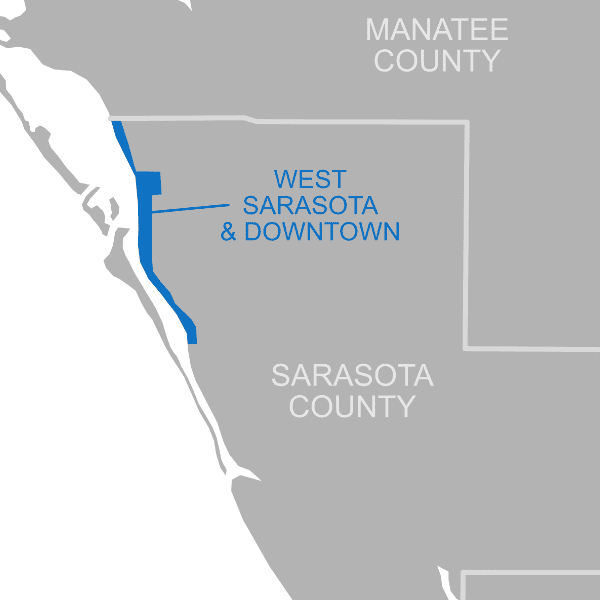
West Sarasota & Downtown

Homes, Lifestyle, & Market Trends
West Sarasota & Downtown includes Downtown Sarasota and mainland properties west of Tamiami Trail, extending south through Osprey and slightly beyond it, while excluding the barrier islands. That definition brings together several very different versions of Sarasota living.

At the northern end, Downtown Sarasota offers condominium living, restaurants, arts, waterfront parks, and the ability to walk to much of daily life. Move south and high-rises give way to established west-of-trail neighborhoods, tree-lined streets, older homes, newer luxury construction, and pockets of bayfront property. Continue toward Osprey and the setting becomes less urban, with more residential neighborhoods and access to Little Sarasota Bay. The common thread is proximity to Sarasota's western waterfront without actually living on one of the keys.

That distinction matters. Buyers considering this area are often trying to balance water access, downtown convenience, neighborhood character, and mainland practicality against the premiums and ownership considerations that can come with living close to the coast.

West Sarasota & Downtown is part of Sarasota County and the Sarasota & Manatee County Overview.

What is West Sarasota & Downtown Like?

The first thing to understand is that West Sarasota & Downtown does not have one personality.

Downtown Sarasota is the most urban part of the HLA. Condominium towers, restaurants, offices, galleries, cultural venues and waterfront parks sit within a relatively compact area. Nearby neighborhoods such as Laurel Park and Burns Court introduce smaller-scale streets, historic architecture and single-family homes within reach of downtown. Visit Sarasota County describes Laurel Park as a shaded neighborhood of historic bungalows immediately beside downtown, while Burns Court is a compact historic district known for cottages, galleries, restaurants and independent businesses. Visit Sarasota County
Move south and Sarasota changes quickly.

Instead of choosing a condo several floors above the city, buyers may be comparing renovated ranch homes, 1920s residences, newer custom construction and larger luxury properties. Neighborhoods around Southside Village, Harbor Acres, McClellan Park and other west-of-trail locations can feel much more residential even though downtown remains nearby.

Farther south, development becomes less intensely urban. Sarasota Bay transitions toward Little Sarasota Bay, and the geography increasingly reflects the bays, creeks and coastal waterways that define this side of the county. Osprey provides a good example. Marie Selby Botanical Gardens' Historic Spanish Point campus occupies 30 acres on Little Sarasota Bay and preserves both natural and historical elements of the area.

So a buyer searching this HLA should not ask only, "Do I want to live west of the Trail?" A better question is, "Which version of west-of-trail living do I want?"

Downtown walkability, a traditional neighborhood, bayfront property and a quiet home farther south may all appear in the same market report, but they deliver very different day-to-day experiences.

West Sarasota & Downtown Lifestyle

The defining advantage of this area is access. Living on the mainland west of Tamiami Trail can put many of Sarasota's best-known destinations close at hand without requiring buyers to live on a barrier island. Downtown restaurants, arts and entertainment are part of everyday life at the northern end of the HLA, while roads heading west connect mainland neighborhoods with Lido Key, Siesta Key and other coastal destinations.

Downtown itself has increasingly become a place where buyers can combine residential life with outdoor space. The Bay, for example, sits along North Tamiami Trail near downtown and includes waterfront green space, walking areas, a kayak launch, lawns, shoreline access and public programming. 

Just south of downtown, Marie Selby Botanical Gardens adds another major bayfront destination. Its Downtown Sarasota campus encompasses 15 acres along Sarasota Bay, while its Historic Spanish Point campus farther south in Osprey occupies another 30 acres along Little Sarasota Bay. 

Walkability Depends Heavily on Where You Buy
This is one of the biggest differences within the HLA. A downtown resident may be able to walk to dinner, coffee, entertainment, parks and services. Some neighborhoods immediately surrounding downtown also make walking or biking practical for certain trips.
That changes as you move south.

Much of the residential area west of Tamiami Trail is still fundamentally car-oriented. A home may be geographically close to restaurants, shopping or the water without making those destinations realistically walkable.

For buyers attracted to the phrase "west of the Trail," the listing photos only tell part of the story. Two homes a few miles apart can offer completely different relationships with shops, restaurants, downtown and the waterfront.

Downtown Versus Neighborhood Living
This is one of the clearest lifestyle decisions in the Sarasota market.

Downtown living can mean restaurants and entertainment close by, condominium convenience, waterfront parks within the urban core, less dependence on a car for some activities, and more activity, traffic and density.

Residential west-of-trail living can mean a private yard, traditional neighborhood streets, more separation from commercial activity, greater control over the property, and more responsibility for exterior maintenance and insurance.

Neither is inherently better. They solve different problems.

A buyer who wants to leave the car parked for dinner may happily trade a private yard for a downtown condominium. Someone who wants a pool, garage, outdoor living area and more privacy may make the opposite decision even if downtown remains only a short drive away.

Access to the Keys Without Living on One
Another reason buyers consider this HLA is its relationship with Sarasota's barrier islands.

Living on Siesta Key, Lido Key, Casey Key, Bird Key or Longboat Key places you directly within a coastal or island environment. West Sarasota & Downtown keeps you on the mainland while maintaining relatively convenient access to many of those areas.
The tradeoff is obvious but important. You do not step outside directly into island life, but you also avoid making a bridge crossing part of every trip inland.

For some buyers, that is exactly the balance they are looking for.

Homes & Housing in West Sarasota & Downtown

Housing variety is one of the strengths of this market, but it also makes broad averages less useful than they might be in a more uniform suburban area.
A downtown condominium and a bayfront estate may both be million-dollar properties while having almost nothing else in common.

Downtown Condominiums
Downtown Sarasota is the HLA's primary condominium market.
Buildings range from established properties to newer luxury developments, and buyers may find everything from smaller units to expansive residences with bay or city views.

For the right buyer, the appeal is straightforward: lock the door and leave, let the association handle much of the exterior maintenance, and live close to downtown amenities.

The financial structure is different from owning a detached house, however.
Condo buyers should look beyond purchase price and monthly association fees. Building reserves, insurance, maintenance obligations, planned projects and potential assessments can materially change the cost of ownership.

That is especially important in Florida, where changes in condominium regulation, structural requirements and insurance have made building-specific due diligence increasingly important.

Two similarly priced condos can represent very different financial commitments depending on the building.

Established West-of-Trail Homes
Outside the downtown core, much of this HLA is known for established residential neighborhoods.

Buyers may encounter older Florida homes, mid-century properties, renovated houses, historic architecture and contemporary infill construction sometimes sitting on the same street.

That creates both character and complexity.

An older house may provide mature landscaping, an appealing lot and an architectural style that would be difficult to reproduce today. It may also require more investigation into plumbing, electrical systems, windows, roof age, drainage or previous renovations.

A newer home may eliminate some of those concerns while commanding a substantial premium.

This is an area where the age of the house itself rarely tells the entire story. A carefully renovated older property can be very different from one that has simply received cosmetic updates before being listed.

Newer Luxury Construction
As land values have risen, some older homes in desirable west-of-trail locations have been replaced by larger contemporary residences.

That gives buyers another choice: buy the original neighborhood architecture, remodel an existing house or pay more for modern construction.

Newer homes may provide current layouts, higher ceilings, larger kitchens, impact-resistant features and modern building standards. Older homes may offer larger established trees, distinctive architecture or lot characteristics that are difficult to replicate.

The tradeoff is often newness versus character, and buyers should decide which matters more before paying a premium for either.

Waterfront and Water-Access Property
Some of the most distinctive real estate in the HLA sits along Sarasota Bay, Little Sarasota Bay, canals and connected waterways.

Waterfront ownership introduces an entirely different set of considerations.
The view may be what sells the house, but buyers also need to understand the physical infrastructure supporting that view.
INVENTORY INSIGHTS
ALL HOME TYPES
399
HOMES ON MARKET
$649k - $3M
TYPICAL PRICE
MEDIAN AGE
20
YEARS
MED SIZE
2,048
SQUARE FEET
NEW CONSTRUCTION
29%
WATER VIEW
28%
WATER ACCESS
43%
HAVE HOA FEES
71%
HAVE CDD FEES
0%
HOA FEES
$14,100
MEDIAN ANNUAL
CDD FEES
MEDIAN ANNUAL
Updated October 6, 2026

West Sarasota & Downtown Real Estate Market

West Sarasota and Downtown experienced a significant tightening in August. Closed sales increased while inventory fell, reducing months of supply from 9.9 to 5.7 months.

That shift moved the area from strongly buyer-leaning conditions toward a more balanced but still buyer-friendly market. Supply remained higher than Sarasota County’s 3.6 months, and homes continued to take longer to sell than they did countywide.

The improvement was meaningful, but it should be viewed in the context of a small market. Only 35 sales closed during August, so individual transactions can produce large changes in monthly statistics.

Who is West Sarasota & Downtown Best Suited For?

This area makes the most sense for buyers who place a high value on location within Sarasota's western mainland.

It may be particularly appealing if you want downtown access but do not necessarily want to live in a downtown tower, or if you want to be close to the barrier islands without putting a bridge between your home and most mainland destinations.

It can also work well for buyers who value established neighborhoods over newer master-planned development.

The area becomes especially interesting for someone whose priorities sound like "I want Sarasota itself to be part of my everyday life, not just somewhere I drive to occasionally."

That may mean walking to dinner downtown. It may mean living on a quiet residential street only a few minutes away. Or it may mean sitting behind your own house looking across the bay.

Those are very different properties, but they share the same geographic advantage.


Buyers Who May Want to Compare Other Areas

West Sarasota & Downtown will not be the automatic choice for everyone.

If you want newer construction, large planned amenities and more predictable neighborhood design, compare East Sarasota or Lakewood Ranch.

If living directly on or near a Gulf beach is the priority, compare the Sarasota Keys.

If you want broader housing choices farther from the premium attached to west-of-trail locations, Central Sarasota may deserve a closer look.

And if your priority is a more suburban or less urban version of southern Sarasota County, communities farther south may offer a different combination of price, housing age and convenience.

The key is deciding what you are actually paying for. In West Sarasota & Downtown, a meaningful portion of the value can come from location itself.

Conclusion

West Sarasota & Downtown is really a collection of choices about how you want to experience Sarasota.

You can live above the city and walk to dinner. You can own a historic or renovated home beneath mature trees. You can choose newer construction in an established neighborhood. Or you can move farther south and put the water, rather than downtown, at the center of the experience.

The tradeoff is that desirable location often comes with higher land values and greater property-specific due diligence, particularly for condominiums, older homes and waterfront real estate.

For many buyers, however, that is precisely why this part of Sarasota remains compelling. You are buying more than a house. You are deciding how closely you want Sarasota's waterfront, downtown and established neighborhoods woven into your daily life.

Zarghami Group | KW Coastal Living III
401 N Cattlemen Road Suite 308
Sarasota, FL 34232
941-241-3622
Subscribe to our newsletter
The latest news, articles, and resources, sent to your inbox.
© 2025 Zarghami Group | KW Coastal Living III. All rights reserved.